Last week on Align’s Facebook page I posted a picture to promote my Postpartum workshop. This picture showed an example of the abdominal “bread loaf” that can occur if the Transversus Abdominus muscle is not activated correctly during daily activities such as bending or lifting and abdominal workouts. The increased pressure is going down into your pelvic floor and out into your abdomen. Over time, supportive tissues can fail, and the results are abdominal/inguinal hernias, organ prolapse (uterus, bladder, rectum) or disc herniations (just to name a few).
In a previous post, I reviewed how to contract the deep abdominal muscle correctly. This is an important skill to master before increasing the demands on the body such as carrying more weight, or moving the limbs. Once the contraction can be performed without holding the breath, it is good to challenge the core by moving the legs. Here is a lower leg progression to advance core control.
In a previous post, I reviewed how to contract the deep abdominal muscle correctly. This is an important skill to master before increasing the demands on the body such as carrying more weight, or moving the limbs. Once the contraction can be performed without holding the breath, it is good to challenge the core by moving the legs. Here is a lower leg progression to advance core control.
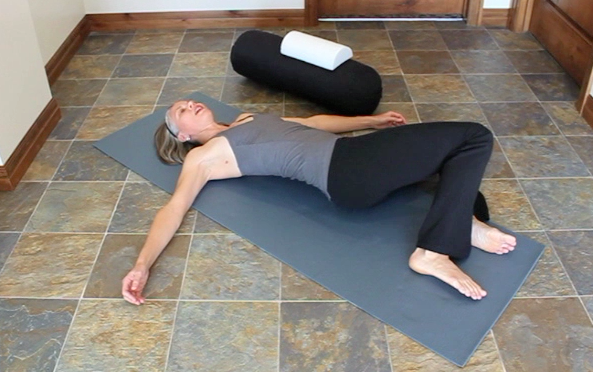
 Lie on your back with your knees bent, and feet flat on floor. Make sure that your pelvic triangle (see dots) is level. Notice your ribs. Can you see in this pic that the ribs are lifted? If your ribs lift like this, you may want to prop something under your shoulders and head so they can come down. |  The head and shoulders have been propped up with a half cylinder under the shoulders and a yoga block under the head. Now the ribs are in alignment and the transversus can have a more effective contraction. The pelvic triangle remains level. |  Activate your Transversus by drawing your belly button toward your spine as you exhale. Lift one leg to ninety degrees as shown, and hold for 1-2 sec. Then lower down. Contract your transversus again and lift the other leg. As you gain more control, contract the transversus, lift one leg to ninety degrees and then alternate legs without having to reset the contraction. Complete 10 repetitions and then rest. |
 When you are able to complete alternate legs without difficulty. Perform transversus activation by drawing belly button toward the spine on the exhale, lift both legs at the same time as shown. There should be no bread loaf. If there is, you are not contracting transversus correctly. Go back to the last step before advancing to this progression. Hold for a few seconds and then lower down slowly on your exhale. You should never hold your breath! Repeat. |  Next progression: From the initial position, place a pillow or yoga block between your knees. Contract your transversus and lift legs to ninety degrees. Gently squeeze into the block. Maintain transversus contraction as you begin to rotate your hips. |  Gently squeeze block as you rotate your hips by moving your feet away from each other, and then return to start position as in prior picture. Perform 10 repetitions and then bring both legs down on your exhale. Repeat 2-3 times. |
Susan McLaughlin is a physical therapist who specializes in the management of pelvic floor and orthopedic dysfunctions. She is the owner of ALIGN integration|movement in Salt Lake City, UT. Helpful tips and other self care strategies can be found at www.alignintegrationandmovement.com.